
Despite its many benefits, I often hear clients say, “A 1031 exchange seems too complicated, I’ll just pay the taxes.” But this common objection reveals a fundamental misunderstanding of the long-term wealth impacts a 1031 exchange strategy can bring.
A 1031 exchange (also known as a like-kind exchange) is a tax-deferral mechanism authorized under Section 1031 of the Internal Revenue Code. It enables owners of investment or business-use real estate to sell one property and reinvest the full proceeds into one or more replacement properties of “like kind,” while legally deferring federal (and often state) capital gains taxes.
In real estate, “like kind” is broadly interpreted, which gives investors flexibility in choosing replacement properties. In general, any investment in real property can be exchanged for any other investment in real property, regardless of specific asset class. However, the strategy doesn’t apply to personal residences, personal vacation homes, or dealer property held primarily for resale.
Eligible participants include individual investors, joint ventures, partnerships, LLCs, S corporations, and C corporations. Additionally, the property must have been held for investment or productive use in a trade or business. There’s also no upper limit on transaction size, making 1031 exchanges especially powerful for high-net-worth individuals and institutional owners with substantial equity.
Virtually all commercial and investment real estate qualifies for a 1031 exchange, including retail centers, industrial warehouses, office buildings, medical offices, multifamily apartments, self-storage facilities, triple-net leased assets, hospitality (in certain cases), land, and even fractional interests when structured properly. This flexibility allows investors to reposition portfolios, moving from aging assets in secondary markets to modern, high-growth properties in stronger locations, without an immediate tax drag.
What’s more, when done correctly with a qualified intermediary and proper timelines (45 days to identify, 180 days to close), the exchange preserves 100% of the equity for reinvestment, creating a compounding advantage that can span generations.
So, why the objection?
Far from a rational cost-benefit decision, objections to the 1031 exchange usually reveal emotional and psychological barriers rather than a clear understanding of the math. In my experience, the key drivers that keep clients reluctant from taking advantage of these benefits include:
While these objections are natural human responses, they frequently lead to decisions that leave significant wealth on the table.
The most persuasive response certified public accountants (CPAs) can offer their clients is to translate the benefits into concrete, client-specific numbers. Generic platitudes about “tax savings” rarely move the needle—but more personalized projections do.
Consider a client selling an investment property for $30 million with a $15 million capital gain who’s facing an approximate 30% combined federal and state tax rate:
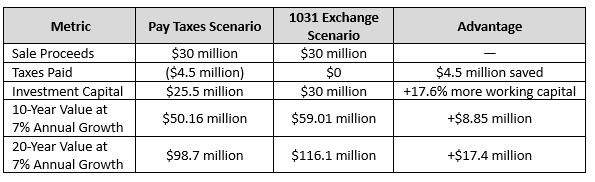
These above projections assume a 7% average annual total return (a conservative blend of appreciation and reinvested cash flow), with no additional leverage, and taxes paid directly out of sale proceeds. Obviously, real-world results will vary based on market conditions, property performance, and future tax rates—but overall, the directional advantage remains compelling.
The $4.5 million “tax bill” isn’t merely an expense, it becomes an $8.85 million opportunity cost over 10 years and a staggering $17.4 million over 20 years. Simply put, the additional $4.5 million doesn’t sit idle—it generates returns that generate returns, all while remaining sheltered.
Further, cumulative wealth from the larger capital base (at 7% growth) looks something like this:
To help reframe the 1031 exchange strategy to your clients, I suggest asking them the following question: “Is simplifying this transaction by paying taxes worth nearly $9 million to you and your family over the next decade—or more than $17 million over 20 years?”
Beyond raw numbers, clients also gain portfolio flexibility with the 1031 exchange. They can diversify across markets, asset classes, or management styles; upgrade to higher-quality, lower-maintenance properties; or increase cash flow without a corresponding tax event. Many also use partial or “reverse” exchanges to acquire larger or more productive assets, further amplifying returns.
Remember, a CPA’s responsibility as a trusted advisor is to replace fears with facts, uncertainties with structure, and short-term thinking with long-term vision. Your guidance can turn a potentially stressful process into a structured, milestone-driven project.
CPAs can address each client’s fear directly through:
Ultimately, every “I’ll just pay the taxes” objection is an opportunity to demonstrate your value far beyond a single transaction. By combining rigorous financial analysis, clear communication, and seamless execution support, you can position yourself as the indispensable advisor who protects and grows client wealth.
When clients are ready to “just pay the taxes,” it’s your cue to initiate a deeper, more strategic conversation. Don’t let fear or misunderstanding erode your clients’ hard-earned equity. With the right education, quantification, and execution support, most clients will recognize that the perceived complexity of a 1031 exchange pales in comparison to the massive opportunity for generational wealth.
Bill Maher is the first vice president and commercial real estate broker with CBRE Private Capital Partners.